
What Building a Property Intelligence Platform for Dubai Govt. Taught Me About Enterprise AI
And the solution went on to close 10+ enterprises in the next 2 quarters

7 months ago, I got my first major project. I was working with stakeholders in Dubai Land Department on a property intelligence use case. We got a one liner problem statement
“Help users derive actionable intelligence from large volumes of real estate and property data.”
Simple.
Until you realize that nobody had clearly defined:
What intelligence meant.
Which data sources mattered.
How users would interact with the system.
What decisions the platform should actually help users make.
Like many enterprise AI projects, the challenge wasn’t technology. The challenge was clarity.
Starting With Questions, Not Features
One mistake I see teams make repeatedly is jumping directly into features. They start discussing models, agents, vector databases, and prompts before understanding the problem.
I deliberately do the opposite. And preach the same
Instead of asking: “What AI should we build?”
I asked: “What is the 1 this this platform will solve for the user?”
That question changed everything.
Rather than creating another dashboard full of charts, I focused on identifying the decisions users struggled to make today.
Property valuation.
Market comparisons.
Investment opportunities.
Location-based insights.
Trend analysis.
Once the decisions became clear, the product started taking shape.
The Architecture Was the Easy Part
Most people assume building the system is the hard part. In AI world, architecture is starting to become easier.
Once we understood the outcomes, we developed the underlying solution:
Data ingestion workflows
Property intelligence objects
Automated processing pipelines
User-facing applications
AI-powered analytical experiences
Workflow automations
Agent-driven interactions
And when I see we, I mean the team of 10 I led who are also product people as we build all of these in our no code platform. Development is also part of our JD.
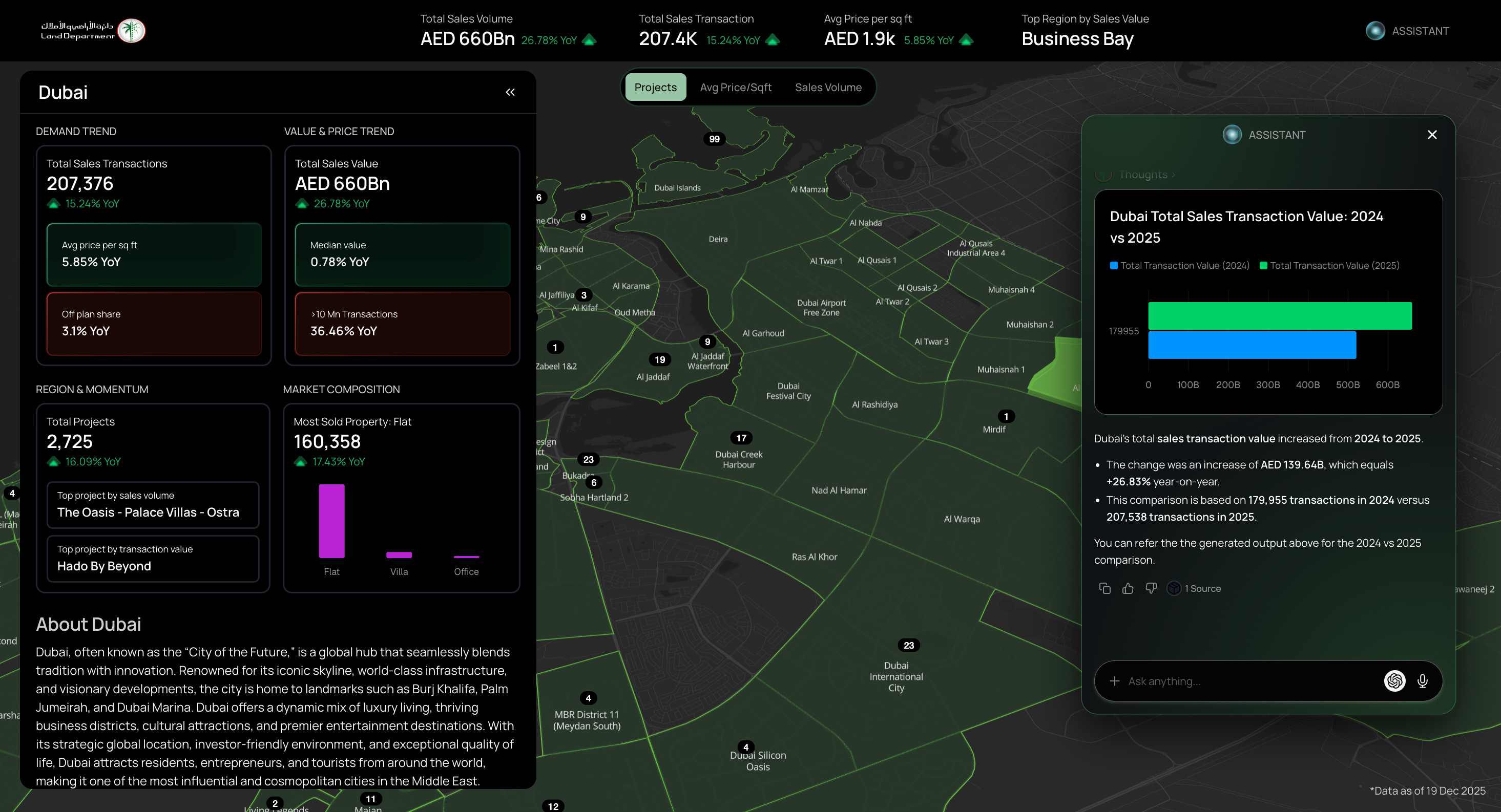
Here’s the homepage of that final solution.
I take pride in this design, as it was my brainchild and it became a standard of our team to deliver Out of the box solutions :)
The Real Challenge: Making Data Trustworthy
One lesson I’ve learned from enterprise AI projects is this:
Users don’t care how intelligent the system is if they don’t trust the output.
Trust becomes the product.
Not AI. Not dashboards. Not automation.
A significant amount of effort went into ensuring that the information presented to users was correct, explainable and traceable.
So we built a Text-2-Sql Agent. Let me explain.
Instead of putting a data on agent and fetch data, we built an agent that writes SQL like a seasoned analyst. We built roughly 100 SQL queries ourselves as test cases and later on went to become Evals. But this approach made sure that we knew where agent could make errors.
In such cases, you’ll generally find agent doing errors in writing filters in queries. And once queries are right, there’s 0% error chance. So this is where product solution approach becomes so critical. And something that a Technical PM should learn.
AI can output whatever you want. But it’s your job to create a framework that it outputs correctly every time and you can pin point exactly the RCA if it’s wrong!
Because one incorrect insight can destroy confidence much faster than ten correct ones can build.
AI Is Only One Layer of the Experience
There’s a tendency in our industry to think AI is the product.
It rarely is.
The best enterprise AI solutions combine multiple layers:
Data architecture
Business workflows
Automation
User experience
Intelligence
AI sits on top of those layers.It doesn’t replace them. Many projects fail because they try to solve organisational problems with a model. The successful ones solve business problems with systems.
What I Learned
Looking back, the biggest lesson wasn’t technical.
It was that enterprise AI success has very little to do with models and a lot to do with problem definition.
The companies that will win with AI aren’t necessarily the ones with the best models.They’re the ones that understand their users deeply enough to identify the right problems to solve.Building the property intelligence platform reinforced a belief I’ve developed over the last few years:
The future belongs to teams that can move from ambiguity to outcomes.
Not from prompts to demos.
Not from ideas to PowerPoint slides.
But from real business problems to real business impact.
And that journey almost always starts with a blank sheet of paper.
And building that path is the skill!
MJ.
Keeping the Tech Bridge in your inbox
On an average, a person receives 1000 emails per week. We take up a space of one. To never miss an edition, reply to one of these emails with “TC” and/or mark it as important. If you happen to miss an edition, do check it out on my Substack account.